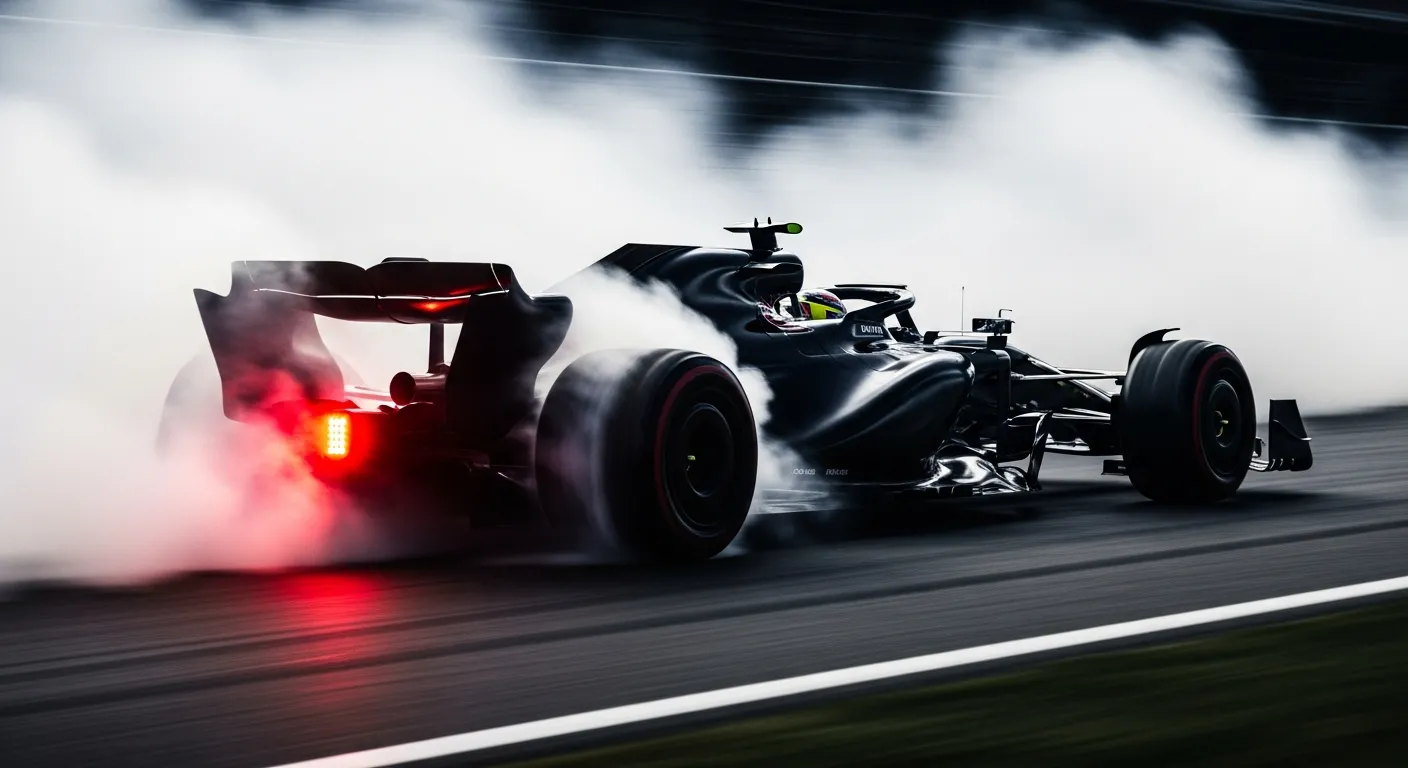
Max Verstappen's drive at the 2024 Azerbaijan Grand Prix was a strategic recovery, transforming a challenging sixth-place grid start into a fifth-place finish, a testament to Red Bull Racing's operational execution on a day marked by incidents elsewhere. Starting from grid position 6, Verstappen navigated the initial phases of the race with a focus on preserving track position and managing tire degradation, a critical factor on the demanding Baku City Circuit. His ability to maintain a consistent pace, even as other competitors faced challenges, was key to his eventual points haul. The notoriously tight castle section and long straights of Baku demand a delicate balance between aggression and precision, a balance Verstappen largely maintained throughout the 51-lap event.
The race saw significant disruption, notably a collision involving his teammate Sergio Pérez, who retired after 49 laps, and a similar incident for [Carlos Sainz at the 2024 Azerbaijan Grand Prix](/results/2024-baku-carlos-sainz). Amidst this, Verstappen steadily worked his way through the field, completing all 51 laps of the race in a total time of 1:34:15.105. His performance included setting the third-fastest lap of the race, a 1:46.798 on lap 42, demonstrating the underlying pace of the Red Bull RB20 when clear air allowed. This strategic application of pace allowed him to secure 10 championship points, an important contribution to his season's tally as detailed on the [Formula 1 — official site](https://www.formula1.com/en).
While not a podium finish, Verstappen's fifth place represented a solid outcome given the starting position and the chaotic nature of the event. The team's strategy, coupled with Verstappen's execution, ensured valuable points were brought home, contrasting with the misfortunes of others. Drivers like [Alexander Albon at the 2024 Azerbaijan Grand Prix](/results/2024-baku-alex-albon), who finished seventh for Williams, and [Oliver Bearman at the 2024 Azerbaijan Grand Prix](/results/2024-baku-oliver-bearman), who secured a point for Haas in tenth, demonstrated that solid, consistent drives were rewarded on this particular Sunday. The intricate details of race results and driver performances are meticulously tracked by data providers like [Jolpica/Ergast — 2026 season data](https://api.jolpi.ca/ergast/f1/2026.json), offering a granular view of each round's dynamics.
This result further solidifies Verstappen's championship campaign, highlighting the importance of maximizing points even on weekends where outright victory is out of reach. The strategic decisions made by Red Bull Racing throughout the 2024 [FIA — F1 World Championship](https://www.fia.com/events/fia-formula-one-world-championship) have consistently aimed at optimizing every race scenario, a characteristic of top-tier [Formula One](https://en.wikipedia.org/wiki/Formula_One) teams. Analyzing the telemetry from such races provides critical insights into vehicle performance and driver inputs, a core aspect of modern [F1 engineering](https://www.formula1.com/en/latest/article.f1-tech-explained-how-telemetry-works-and-why-it-is-so-important.3s1e7nB2t2W222A222Q222.html). The comprehensive race data, often analyzed for trends and performance metrics, provides insights into how drivers and constructors navigate the challenges of a grand prix weekend, as seen in the detailed statistics available on the [Formula 1 — official site](https://www.formula1.com/en) and through various [F1 data sources](https://api.jolpi.ca/ergast/f1/2026.json). The ability to adapt and score points under adverse conditions is a hallmark of a championship contender.